
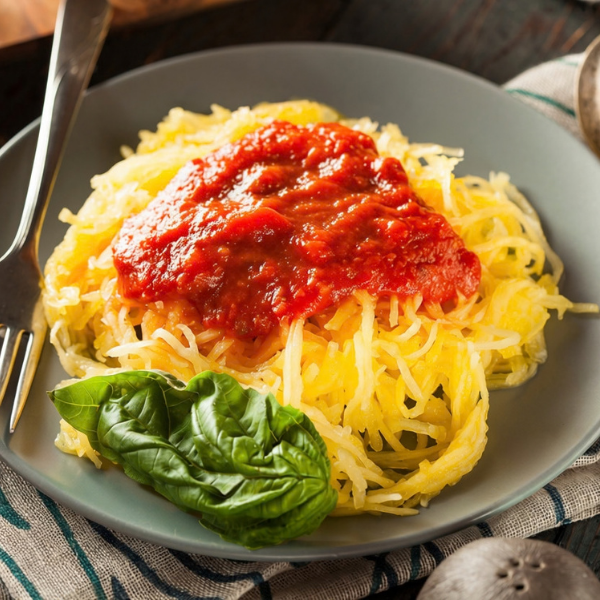
Spaghetti squash is one of those ingredients I always keep on hand in the fall. It’s warming, satisfying and endlessly versatile and this recipe is the simplest way to enjoy it.
Below you’ll find everything you need to make this a weekly staple: two easy cooking methods, a hormone-loving grass-fed meat sauce, and tips for making it perfect every time.
Why Spaghetti Squash Supports Hormone Balance
There’s a lot to love about spaghetti squash. Here’s why it’s such a beautiful choice when you’re eating for hormone balance:
🍝 It’s naturally low-glycemic — which means it supports steady blood sugar and calmer cortisol. Blood sugar balance is one of the most important pieces of hormone balance.
🌿 It’s rich in vitamin C — nourishing your adrenals, supporting progesterone production, and helping your body handle stress with more ease.
✨ It’s a beautiful source of B6 — a nutrient your body needs to make progesterone and support calm moods.
🧡 It’s loaded with beta-carotene — which converts to vitamin A in the body, supporting immune health, skin and hormone production.
💛 It’s high in fiber — supporting gut health and helping your body gently eliminate excess estrogen. Gut health and hormone health are deeply connected.
The best part? Spaghetti squash is incredibly versatile,satisfying, warming and the perfect base for all kinds of cozy fall meals.

How to Cook Spaghetti Squash — Two Easy Methods
Cooking spaghetti squash is simpler than you might think. Here are my two favorite methods, one for when you have time and one for when you don’t.
Oven Method (Classic)
About 50 minutes
- Preheat your oven to 400°F.
- Carefully cut the spaghetti squash in half lengthwise. Scoop out the seeds with a spoon.
- Drizzle the inside with olive oil and sprinkle with sea salt and black pepper.
- Place the squash halves cut-side down on a parchment-lined baking sheet.
- Roast for 40 to 50 minutes, until the flesh is tender and easily shreds with a fork.
- Let cool slightly, then use a fork to scrape the flesh into noodle-like strands.
Instant Pot Method (Quick)
About 15 minutes
- Carefully cut the spaghetti squash in half lengthwise. Scoop out the seeds.
- Add 1 cup of water to the Instant Pot and insert the trivet.
- Place the squash halves cut-side up on the trivet.
- Seal the lid and cook on high pressure for 7 minutes.
- Quick release the pressure. Carefully remove the squash and let cool slightly.
- Use a fork to scrape the flesh into noodle-like strands.
The Grass-Fed Meat Sauce Recipe
Simple Grass-Fed Meat Sauce
Serves 4
Ingredients:
- 1 lb grass-fed and finished ground beef
- 1 Tbsp extra virgin olive oil
- ½ medium yellow onion, finely chopped
- 3 garlic cloves, minced
- 1 (24 oz) jar organic marinara sauce (no sugar added) (optional — omit if you don’t tolerate nightshades)
- 1 tsp dried oregano
- 1 tsp dried basil
- ½ tsp sea salt
- ¼ tsp black pepper
- Pinch of red chili flakes (optional — for a little kick)
- Fresh basil or parsley, for topping
Directions:
- Heat the olive oil in a large skillet over medium heat. Add the chopped onion and cook for 3 to 4 minutes, until softened.
- Add the minced garlic and cook for another 30 seconds, until fragrant.
- Add the ground beef and brown, breaking it up with a spoon, until fully cooked through, about 6 to 8 minutes.
- Drain any excess fat if needed.
- Pour in the marinara sauce and stir to combine. Add the oregano, basil, sea salt, pepper, and chili flakes if using.
- Simmer uncovered for 10 to 15 minutes, until the sauce has thickened slightly.
- Serve warm over cooked spaghetti squash strands. Top with fresh basil or parsley.
Always use organic ingredients whenever possible.
How to Make This a Complete Hormone-Balancing Meal
This spaghetti squash with grass-fed meat sauce brings healthy protein from the beef and healthy fats from the beef and olive oil. It’s wonderful on its own alongside a simple green salad or roasted broccoli for a light, satisfying dinner.
If you’d like to turn it into a fully complete hormonally balanced meal, with healthy protein, fats and carbohydrates, add a small starchy carbohydrate on the side.
A few of my favorites:
– A small baked or roasted sweet potato
– A scoop of wild rice or quinoa
– A few slices of roasted delicata or acorn squash
Remember, a hormonally balanced meal always includes three things: healthy protein, fats and carbohydrates.
A Few Tips for the Best Spaghetti Squash
Choose a firm, heavy squash: Look for a spaghetti squash that feels firm, heavy for its size and has pale yellow skin. Avoid any with soft spots, cracks or green patches (which indicate underripeness).
Safely cut your squash: Spaghetti squash can be tough to cut. Use a sharp, sturdy knife and start by trimming off the stem for stability. If it’s really hard to cut, microwave the whole squash for 3 to 5 minutes to soften the skin slightly before cutting.
Save the seeds: Just like pumpkin seeds, spaghetti squash seeds can be rinsed, tossed with olive oil and sea salt and roasted at 350°F for 15 to 20 minutes for a hormone-supporting snack.
Don’t overcook it: Spaghetti squash should still have a slight bite. Overcooked squash becomes mushy and loses its noodle-like texture.
Make it ahead: Cooked spaghetti squash keeps in the fridge for up to 4 days. Make a big batch and use it throughout the week for different meals.
Frequently Asked Questions
What does spaghetti squash taste like?
It has a mild, slightly sweet flavor and a noodle-like texture when cooked. It’s wonderfully satisfying on its own, and even better when paired with a flavorful sauce like this grass-fed meat sauce.
Can I use any ground meat for the sauce?
Absolutely. Grass-fed and finished ground beef is beautiful, but ground bison, ground turkey, ground lamb, or even Italian-style ground chicken all work well.
Can I meal prep spaghetti squash?
Yes! Cook a whole squash at the start of the week and keep the strands in an airtight container in the fridge for up to 4 days. Reheat gently on the stovetop or in a skillet with a little olive oil before serving.
What other ways can I enjoy spaghetti squash?
Spaghetti squash is incredibly versatile. Try it with pesto and grilled chicken, in a Pad Thai-style dish with almond butter sauce, tossed with olive oil, garlic, and sautéed shrimp, or as a bed for your favorite stir-fry.
There’s real joy in eating food that both tastes good and supports your body. This spaghetti squash with grass-fed meat sauce is exactly that warm, satisfying and truly nourishing.
Simple, beautiful, and truly nourishing. Enjoy every bite. 💛
Love,
Robin xo
Want more simple, hormone-supporting recipes and steady weekly support? Come join us in NHS Circle. It’s where women like you find the rhythm that changes everything. Join here!